* Please download the newest version 4.1 *
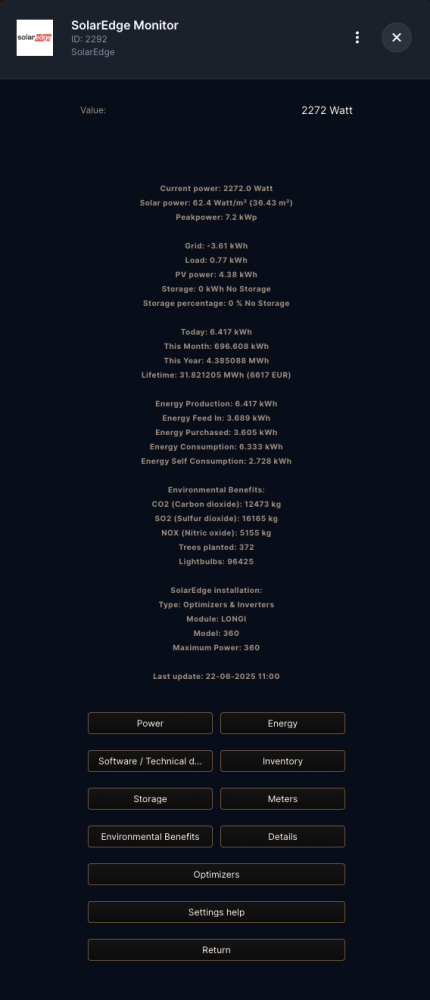
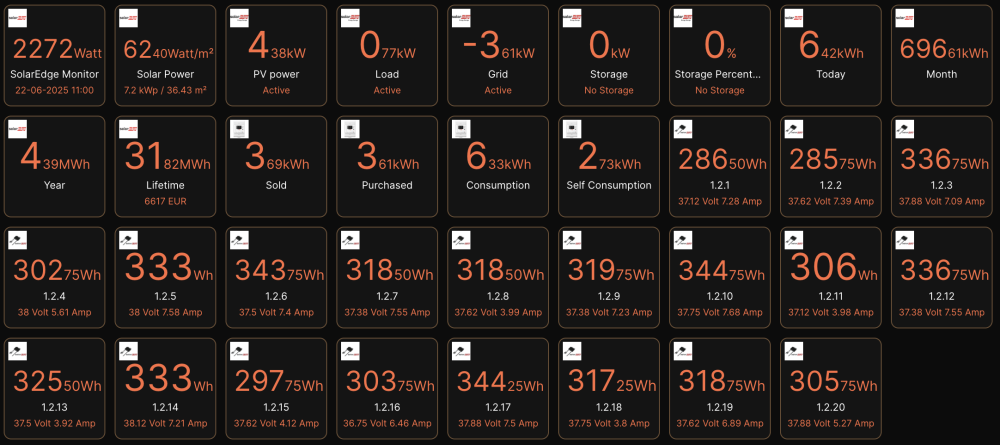
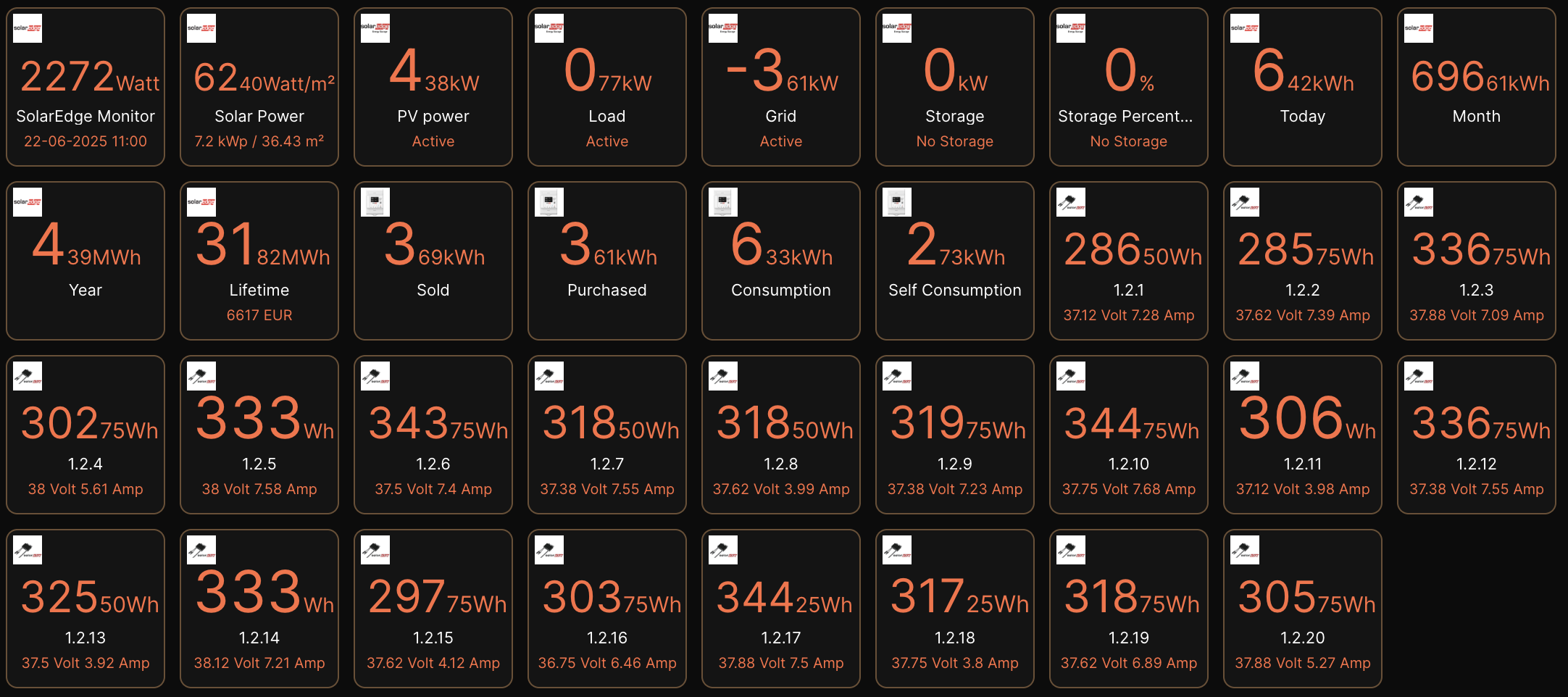
This QuickApp monitors your SolarEdge managed Solar Panels and has 5 child devices for Solar Power, Lastday Data, Lastmonth Data, Lastyear Data and Lifetime Data.
If you have an extra SolarEdge Energymeter, then 4 extra child devices for Consumption, SelfConsumption, FeedIn and Purchased are available.
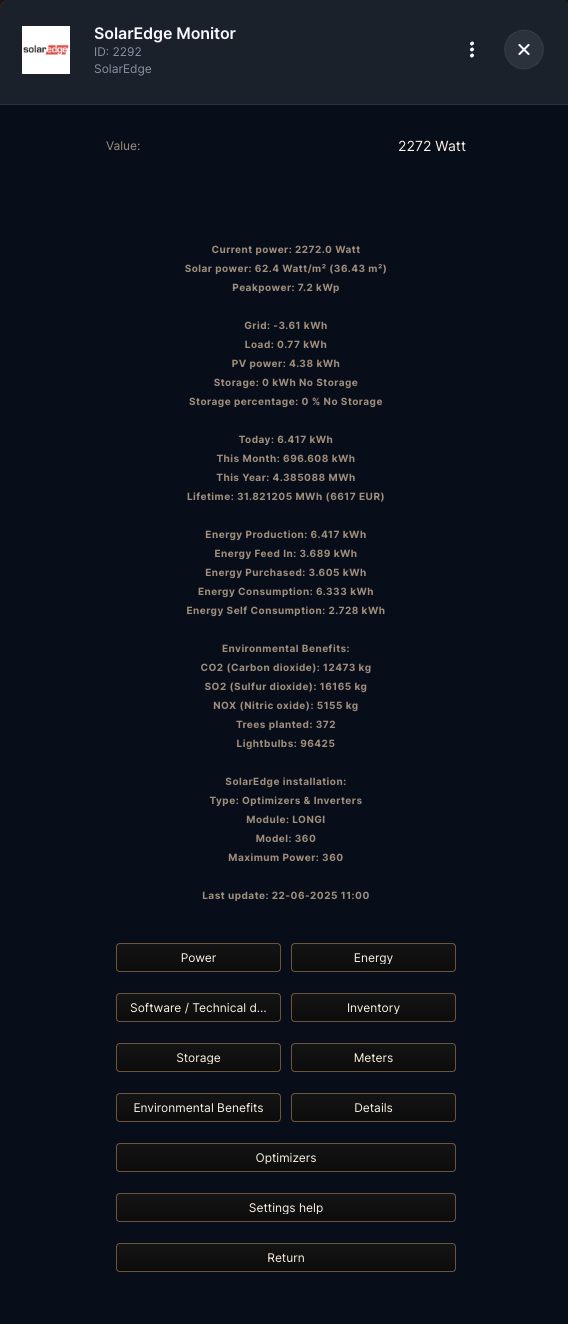
The QuickApp also shows the Environmental Benefits in the labels for CO2, SO2, NOX, Trees planted and Lightbulbs and the Environmental Benefits are updated once a day after 12:00 hour (or if you hit the Benefits button). The QuickApp also shows the SolarEdge Installation details in the labels.
The Solar Production values are only requested from the SolarEdge Cloud between sunrise and sunset, so the daily API limitations are handled optimal.
This QuickApp also gets extra information from your SolarEdge managed Solar Panels to give you the most insight of your SolarEdge installation, by using the buttons.
- Power: Return todays site power measurements (Watt) in 15 minutes resolution.
- Energy: Return todays site energy measurements (Wh) in 15 minutes resolution.
- Technical data: Return specific inverter data for a given timeframe.
- Inventory: Return the inventory of SolarEdge equipment in the site, including inverters/SMIs, batteries, meters, gateways and sensors.
- Storage: Get detailed storage information from batteries: the state of energy, power and lifetime energy.
- Meters: Returns for each meter on site todays energy reading, metadata and the device to which it’s connected to.
- Optimizers: Returns all detail for each optimizer.
- Software: Returns all software/firmware details of your Inverter.
- Environmental Benefits: Returns all environmental benefits based on site energy production: CO2 emissions saved, equivalent trees planted, and light bulbs powered for a day.
- Site Details: Displays the site details, such as name, location, status, etc.
- Credentials: siteID, apiKey, serialNumber, reporterID, username and password in a label. Please handle this button with care to keep your credentials secure. You can turn this button on and off with the QuickApp Variable 'credButton' (default = false). The credentials will only show for 4 seconds.
- Settings: Help for setup of the Quickapp Variables.
The settings for Peak Power and Currency are retrieved from the inverter
The rateType interface of Child device Last Day is automatically set to "production" and values from this child devices can be used for the Energy Panel
The readings for lastyear and lifetime energy are automatically set to the right Wh unit (Wh, kWh, MWh or GWh)
Use of the monitoring server API is subject to a query limit of 300 requests for a specific account token and a parallel query limit of 300 requests for each specific site ID from the same source IP. The monitoring server API allows up to 3 concurrent API calls from the same source IP. Any additional concurrent calls will return HTTP 429 error – too many requests. Any additional site or account level request will result in HTTP 429 error – too many requests.
See API documentation on https://www.solaredge.com/sites/default/files/se_monitoring_api.pdf
Site Power:
- Type - i.e. Production, Consumption, SelfConsumption, FeedIn (export) or Purchased (import)
- Value - Power in Watt at that time of the day (Unit - the measurement units (e.g. Watt))
- Date - Date and time
Site Energy:
- Type - i.e. Production, Consumption, SelfConsumption, FeedIn (export) or Purchased (import)
- Value - Power in Wh at that time of the day (Unit - the measurement units (e.g. Wh))
- Date - Date and time
Inverter Software/Technical data:
- AC Energy Off Grid
- AC Energy On Grid
- Total Active Power
- DC voltage
- v L1 To 2 (3ph only)
- v L2 To 3 (3ph only)
- v L3 To 1 (3ph only)
- Power Limit %
- Ground Fault Resistance
- Per phase:
- Active Power - Supported starting communication board version 2.474
- AC Voltage
- AC Current
- AC DC Current
- Apparent Power - Supported starting communication board version 2.474
- Reactive Power
- Cos Phi (divided per phase)
- Software:
- Inverter Name
- Inverter Country
- Inverter Manufacturer
- Inverter Model
- Inverter Type
- Inverter Serial number
- Inverter Status
- DSP1 Version
- DSP2 Version
- Communication Board (CPU) Version
- Timestamp - last update
Inventory:
- Inverter
- Name – The inverter name e.g. Inverter 1
- Manufacturer – Manufacturer name (SolarEdge)
- Model name - e.g. SE16K
- Firmware version - e.g. 2.52.311
- Communication Method – The communication interface used to connect to server. e.g.: Ethernet or WIFI.
- Serial Number – The equipment serial number e.g.: 7F123456-00
- Connected Optimizers – Number of optimizers connected to the inverter
- Meters
- Name – The inverter name e.g. “FeedInMeter”
- Manufacturer – e.g. “WattNode”
- Model – Meter model number
- SN – Serial number (if applicable)
- Type – Metertype, e.g. “Production”
- Firmware Version (if applicable)
- Connected To – Name of SolarEdge device the meter is connected to
- Form – Physical for a HW meter or virtual if calculated by arithmetic between other meters
- Connected Solaredge Device SN – serial number of the inverter/gateway the meter is connected to
- Sensors (Irradiance/wind/temperature sensors)
- ID – e.g. “SensorDirectIrradiance”
- Connected To – Name of the device it is connected to e.g. “Gateway 1”
- Category – e.g.IRRADIANCE
- Type – e.g. “Plane of array irradiance”
- Connected Solaredge Device SN – the S/N of the device it is connected to e.g. 12345678-00
- Gateways
- Name – the inverter name e.g. Inverter 1
- Serial Number – the equipment serialnumber e.g. 7F123456-00
- Firmware version
- Batteries
- Name
- Serial Number
- Manufacturer - the battery manufacturer name
- Model - the battery model name
- Nameplate capacity - the nameplate capacity of the battery as provided by the manufacturer
- Firmware version
- Connected To – Name of SolarEdge device the battery is connected to
- Connected Solaredge Device SN – serial number of the inverter/gateway the battery is connected to
Storage information:
- Serial Number - The battery serial number
- Nameplate - The nameplate (nominal) capacity of the battery
- Model Number – Battery model number
- Telemetries - A list of storage data telemetries. each entry contains:
- Power - Positive power indicates the battery is charging, negative is discharging.
- Battery State - Can be one of the following: 0 (Invalid), 1 (Standby), 2 (Thermal Mgmt.), 3 (Enabled), 4 (Fault)
- LifeTime Energy Charged - The energy Charged from the battery in Wh, during battery lifetime.
- LifeTime Energy Discharged - The energy discharged from the battery in Wh, during battery lifetime.
- Full Pack Energy Available - The maximum energy (Wh) that can currently be stored in the battery. Note that the battery state of health (SoH) can be calculated from this value. SoH is defined as Full Pack Energy available today/Full Pack Energy available on day one. Full pack energy available on day one can be extracted from the battery nameplate value or battery model information. Both the battery name plate value and model number are provided by the storageData method.
- Internal Temp - Battery internal temperature in Celsius.
- AC Grid Charging - Amount of AC energy used to charge the battery from grid within a specified date range in Wh.
- State Of Charge – The battery state of charge as percentage of the available capacity. Values are in the range of 0 to 100 (percentage).
- TimeStamp - String - Telemetry timestamp in the format of YYY-MM-DD HH:MM:SS
Meters information:
- Meter Serial
- Connected Solaredge Device Serial Number (Inverter to which the meter is connected to)
- Model Meter
- Meter Type (Production, Consumption, FeedIn or Purchased)
- Value (Lifetime energy reading) Unit (Wh)
- Date Measurement
Optimizers:
- Panel number
- Panel Manufacturer
- Panel Model
- Optimizer Type
- Optimizer ID
- Optimizer Serial Number
- Optimizer Voltage
- Voltage" (Volt)
- Current (Amp)
- Power (Watt)
Environmental Benefits:
- CO2 - Quantity of CO2 (Carbon dioxide) emissions that would have been generated by an equivalent fossil fuel system
- SO2 - Quantity of SO2 (Sulfur dioxide) emissions that would have been generated by an equivalent fossil fuel system
- NOX - Quantity of NOX (Nitric oxide) emissions that would have been generated by an equivalent fossil fuel system
- TreesPlanted - Equivalent planting of new trees for reducing CO2 levels
- LightBulbs - Number of light bulbs that could have been powered by the site for a day
Site Details:
- ID – The site ID
- Name – The site name
- Account id – The account this site belongs to
- Status – The site status (Active – The site is active, Pending Communication – The site was created successfully however there is no communication yet from its
- inverters/SMI)
- Peak power – Site peak power
- Currency - e.g. EUR
- Installation Date – Site installation date (format: yyyy-MM-DD hh:mm:ss )
- ptoDate – Permission to operate date
- Notes - Extra notes about the site
- Type – Site type (Optimizers and inverters, Safety and monitoring interface, Monitoring combiner boxes)
- Location: Country, state, city, address, secondary address, zip, time zone
- Alert Quantity - Number of open alerts in this site *
- Alert Severity – The highest alert severity in this site *
- Public Settings: is Public - If this site is public (true or false), public name
- Last update
* Alert information is only available when using an API_KEY generated by an account. API_KEY generated at the site level does not return this information.
Changes version 4.1 (22nd June 2025)
- Added PowerFlow query with extra childs for Grid (kW), Load (kW), PV (kW), Storage (kW) and Storage percentage. The childs can be created by setting the QuickApp Variable 'powerFlow' to true. These child give an insight on how many power flows from or to the Grid, Load and Storage, how many power flows from the PV and shows the percentage of the Storage. If Storage drops below 10%, 'Storage critical❗️' will be shown in de log text.
- Combined the Software and Technical data query with one button an run the query outsite the API.
- Rounded the Current Power, Solar Power and Lifetime Energy in the labels.
- Formatted the Last Update Date for the Optimizer/Panel values.
- Added a new button to show all credentials siteID, apiKey, serialNumber, reporterID, username and password in a label. Please handle this button with care to keep your credentials secure. You can turn this button on and off with the QuickApp Variable 'credButton' (default = false). The credentials will only show for 4 seconds.
- Added a new button to show help on the settings of the Quickapp Variables.
- Improved the warning and debug message of the panel request, added the panel number to the warning and debug message.

Variables (mandatory and created automatically):
- siteID = Site ID of your SolarEdge Inverter (stored encrypted) (see your Inverter Site Details)
- apiKey = API key of your SolarEdge Inverter (stored encrypted) (contact your installer if you don't have one)
- serialNumber = Short serialNumer (stored encrypted) of your SolarEdge Inverter, automaticaly generated (!) if you run the 'Inverter' function (needed for 'Storage' query)
- reporterID = ID of your inverter (stored encrypted), automaticaly generated (!) if you run the 'Optimizer' function (needed for 'Software/Technical data' query)
- username = Username of your SolarEdge Cloud login (stored encrypted) (needed for 'Optimizers' and 'Software/Technical data' query)
- password = Password of your SolarEdge Cloud login (stored encrypted) (needed for 'optimizers' and 'Software/Technical data' query)
- systemUnits = SystemUnits is Metrics (kg) or Imperial (Lb) (default is Metrics)
- solarM2 = The amount of m2 Solar Panels (use . for decimals) for calculating Solar Power m2 (default = 0)
- language = Preferred language (default = English (en)) (supported languages are English (en), Dutch (nl), French (fr), Italian (it), German (de), Spanish (es), Swedish (sv), Norwegian (no), Portuguese (pt) and Danish (da))
- interval = The daily API limitation is 300 requests. The default request interval is 300 seconds (6 minutes = 240 requests)
- httpTimeout = How long to wait for a response from SolarEdge (default = 5 seconds)
- optimizers = If you have optimizers for you solar panels an if true, then for every Optimizer a child devices will be created (default = false)
- energyMeter = If you have the SolarEdge Inline Energymeter and if true, then four extra childs devices will be created for Consumption, SelfConsumption, FeedIn and Purchased (default = false)
- powerFlow = If true then five extra childs devices will be created for Grid, Load, PV, Storage and Storage percentage (default = false)
- credButton = If true then the credentials button will show (default = false)
- pause = Should the SolardEdge go in pause mode after sunset to save on daily API limitations (default = true)
- debugLevel = Number (1=some, 2=few, 3=all) (default = 1)
How to install:
- Open the Configuration Interface
- Go to Settings > Devices
- Click +
- Choose Other Device
- Choose Upload File
- Choose file from your computer with .fqax



Dutch Discord: https://discord.gg/4snW4FJmTh